The situation
There’s a version of how a business operates on paper.
And then there’s what actually happens behind the scenes.
Most of the time, those two don’t match.
From the outside, things look functional. Work gets done. Customers are served. The business keeps moving.
But underneath that surface, small gaps start to show.
Information lives in too many places.
Processes depend on specific people.
Updates happen when there’s time, not when they’re needed.
And that’s usually where things start to break down. Not all at once, but gradually.
In this case, the issue wasn’t effort. And it wasn’t awareness either.
It was that there wasn’t a single, reliable place to access what the business depended on.
Customer data existed, but it didn’t exist in a way that supported the people actually doing the work.
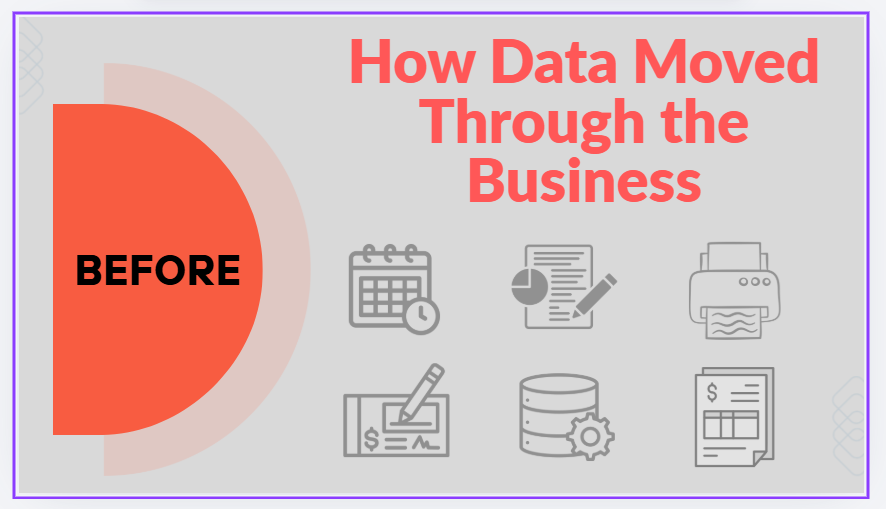
The main database lived in Excel files on one office computer.
Files had to be shared manually.
And even when they were, not everyone knew how to navigate them.
So updates depended on one person having the time to make them.
Which meant the most accurate information usually wasn’t in the system at all.
It lived in paper stacks.
In service tickets.
Or in someone’s memory.
And if you needed something, you had to know where to look or who to ask.
Not because the business lacked structure, but because the structure didn’t match how the business actually operated.
What became clear
What became clear pretty quickly was that the issue wasn’t a lack of effort or even a lack of data.
It was that the business was operating without a system that could support it at scale.
Key responsibilities were concentrated in a few individuals, not because they were designed that way, but because they had to be. They were the only ones who knew how to access, interpret, or update critical information.
That created a bottleneck where everyday operations depended on availability rather than structure.
And over time, that kind of dependency doesn’t just slow things down.
It limits how the business can function and grow.
What most people do
In situations like this, the instinct is usually to look for a tool to fix it.
A CRM gets introduced. New software is added. Processes are built around whatever platform is selected.
On the surface, it feels like progress.
But in most cases, the underlying structure hasn’t actually changed.
The same gaps still exist.
The same dependencies are still there.
They’re just now happening inside a different system.
And instead of simplifying operations, the business ends up adjusting itself to fit the tool, rather than the other way around.
What I did instead
Instead of starting with a tool, I started by understanding how the business actually operated.
I worked within the existing system and focused on how data was created, where it moved, and where it was getting lost. I spoke directly with the people involved, executives, technicians, and administrative staff, to understand who needed what information and when.
That made it clear what the organization actually depended on day to day.
At one point, I considered bringing in a CRM. But nothing available fit the combination of budget, operational needs, and simplicity the business required. Most options introduced more complexity than they solved.
So instead of forcing a tool into the process, I shifted the approach.
I began building a system around what the business actually needed. That meant researching, testing, and identifying a path that was both technically feasible and aligned with how the company operated.
Once that direction was clear, I mapped out the structure and presented it to the executive team before moving forward with development.
See it in action
If you want to see how this system was designed and implemented in detail, you can explore the full case study below.